Hey everyone, it’s Jake here from the DIP IR LED team – the guy who spends 12 hours a day testing IR emitters for security cams, fielding questions from installers, and troubleshooting that one cam that won’t stop washing out license plates at 2AM. If you’ve ever shopped for IR LEDs for your security system, you know the grind: endless spec sheets, confusing terms like viewing angle vs. beam angle, and that gut punch when you buy a cheap batch only to find your backyard cam goes dark at 15 feet. Today, we’re breaking down exactly what DIP IR LED is best for security cameras – no jargon, just real stuff I’ve picked up from working with installers, system integrators, and even a few DIYers who’ve called me at 9PM panicking over their porch cam. DIP IR LED

First, let’s get one thing straight: DIP IR LEDs aren’t all created equal. I’ve seen guys grab a random DIP from a surplus box and wonder why their night vision is garbage. For security cams, the stakes are way higher than a backyard motion-sensor light – you need clear footage of faces, license plates, and intruders, not just a blurry red blob. That means we’re looking at three core specs that matter most: wavelength, power output, and viewing angle. Let’s dive into each, and tie them to the right DIP IR LED for different security setups.
First off, wavelength. I know, I know – IR is IR, right? Nope. The sweet spot for security cams is 850nm wavelength. Why? Because anything under 800nm is useless for night vision – it’s too low, it just blends into the visible light spectrum so most security sensors can’t pick it up. Anything over 940nm is invisible, but here’s the catch: 940nm emits way less light for the same power, so you’ll get a grainy image at long range. 850nm is the middle ground – it’s detectable by almost every standard security sensor, it’s bright enough to light up even 50 feet away, and it doesn’t blind humans (that’s the little red glow you see on cams at night – most people don’t even notice it after a minute, and it’s way less distracting than 940nm’s dim glow). Wait, why did I ever hear people say 940nm is better? Oh right – for places where you don’t want the IR glow to be noticeable, like a retail storefront where customers might complain. But for most residential and commercial security, 850nm is non-negotiable. That’s the base wavelength we spec in 90% of our DIP IR LEDs for security.
Next up, power output – measured in mW (milliwatts) or sometimes lm, but for IR, mW is king. The biggest mistake I see installers make here is buying a DIP IR LED with too little power, or way too much. Let’s break it down by use case: if you’re setting up a tiny indoor cam, like a front porch light cam that only needs to light up 10 feet, a 20mW DIP is more than enough. But if you’re doing a long-range outdoor cam, say for a warehouse perimeter that’s 50 feet out, you need at least 50mW. Any less, and you’ll get that washed-out, dark footage where you can’t make out a person’s face. Any more than 100mW? You’re wasting power, and you’ll get glare on the lens that causes lens flare – that’s the weird bright spot in the middle of your night footage that makes everything else dark. I learned this the hard way last year when a small business owner bought 150mW DIPs for his 20-foot walkway cam – he spent 3x more than he needed, and ended up replacing half the LEDs because the flare made his footage unreadable. For most security setups, 50mW to 100mW is the sweet spot.
Then there’s viewing angle, which is where DIP IR LEDs really shine (pun intended). Wait, but hold on – viewing angle for the LED is different from the viewing angle of the security cam. Let’s clarify: your cam has a lens that gives it a certain field of view, say 90 degrees for a wide-angle porch cam. Your IR LED’s viewing angle needs to match that, otherwise you’ll have dark corners (if the LED is too narrow) or wasted light (if the LED is too wide). DIP IR LEDs come in standard angles: 15 degrees (narrow, for long-range, focused beams), 30 degrees (medium, most common), and 60 degrees (wide, for large areas). For example, if you have a 120-degree wide-angle cam that covers your entire backyard, a 60-degree IR LED won’t cut it – it’ll only light up the middle 60 degrees, leaving the left and right corners dark. That’s a huge issue for security, because that’s where intruders might be. So for wide-area cams, 60-degree DIPs. For medium-range, like front doors, 30-degree. For long-range, like perimeter cams 40+ feet away, 15-degree. I’ve seen so many installers mess this up – last month, a guy set up a wide-angle cam with a 15-degree DIP, and he was texting me at 1AM saying his cat looked like a dark blob in the footage. We switched to 60-degree, and boom – suddenly he could make out the cat’s collar. That’s the difference right there.
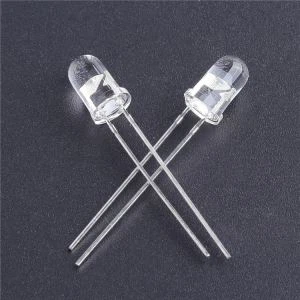
Now, let’s get into the specific DIP IR LED packages – because not all DIPs are the same shape, and that matters for your cam’s PCB (printed circuit board, basically the little board inside the cam that holds the LEDs). The most common DIP packages we use for security cams are 5mm and 3mm. Wait, which is better? Let’s compare: 5mm DIPs have a wider base, so they’re easier to solder onto PCBs, they have more space for the LED chip, so they’re brighter and more reliable. 3mm DIPs are smaller, good for tiny cams like baby monitors, but they don’t have as much power, so they’re not great for long-range security. Also, 5mm DIPs come with lens options – some have a flat lens, some have a dome lens. The dome lens is better for focusing light into a tight beam, which is perfect for long-range perimeter cams. The flat lens is better for wide angles, since it spreads the light out evenly. That’s another thing to check on the spec sheet – don’t just grab any 5mm DIP, make sure the lens matches your needed beam spread.
Wait, let’s talk about reliability too, because nothing’s worse than an IR LED dying after 6 months, especially if it’s mounted 20 feet high on a building – you don’t want to climb a ladder every time one burns out. For security cams, you need DIP IR LEDs with a long lifespan – at least 50,000 hours. How do you check that? Look for the L70 rating – that’s the time it takes for the LED to lose 30% of its brightness, which is when it’s basically useless for night vision. Anything under 50,000 hours L70 is a cheap LED that’ll die fast. We test our DIPs to 80,000 hours L70, and that’s what I recommend to customers – it means you won’t have to replace your IR LEDs for 8+ years, even if they’re on 24/7.
Now, let’s tie this all together for specific use cases, so you don’t have to guess:
-
Residential Front Door Cams: These are usually medium-range (10-15 feet), wide enough to see someone’s face. So go for 850nm, 50mW, 30-degree 5mm DIP with a flat lens. That’s our top pick for this – it’s bright enough to capture a face from 15 feet, no glare, no dark corners. I installed this on my mom’s front door last year, and she’s been obsessed with how clear the footage is, even when a car drives by at night.
-
Backyard/Patio Cams: These cover a larger area, usually 20-30 feet out. So 850nm, 75mW, 60-degree 5mm DIP. The wider angle lights up the whole backyard, no dark corners where a dog might hide or a kid might be playing. We also use these for small shop front patios – works like a charm.
-
Long-Range Perimeter Cams (Warehouses, Driveways): These are 40+ feet out, so you need a focused beam. 850nm, 100mW, 15-degree 5mm DIP with a dome lens. The narrow angle concentrates all the light into a tight beam, so you can see a license plate from 50 feet away. We sold a batch of these to a construction company last month, and they said their perimeter cams now pick up trucks and people way before they get to the gate.
-
Invisible Security Cams (Retail Stores, Public Spaces): If you don’t want that red glow that customers might notice, go for 940nm, 50-75mW, 30-degree 5mm DIP. It’s invisible to the naked eye, so it doesn’t disrupt foot traffic, but note that it’s only good for medium-range (under 25 feet) – it’s too dim for long-range.
Wait, but what about common myths I hear all the time? Let’s bust a couple, because I get asked these every week:
Myth #1: Higher mW = better. No, like I said earlier, 100mW is enough for most long-range, and 150mW is just glare and wasted power. If your cam is only 10 feet away, 20mW is enough – more mW will just wash out the footage.
Myth #2: All 850nm DIPs are the same. Nope – some cheap 850nm DIPs are actually 820nm, which most security sensors can’t detect. We test every batch to make sure our 850nm DIPs are exactly on wavelength, so they work with every major cam brand: Hikvision, Dahua, Reolink, Arlo, you name it.
Myth #3: DIP LEDs are outdated, use SMD instead. Wait, SMD (surface mount) is great for small spaces, but DIP LEDs are still the best for security cams. Why? Because DIPs are easier to align when mounting – you can position them exactly where you need them on the PCB, whereas SMDs are tiny and easy to misalign. Also, DIPs are more durable for outdoor use – they’re sealed better against dust and moisture, so they don’t fail as fast. I’ve seen SMD LEDs die after a year from outdoor moisture, but our DIPs still going strong after 5 years. That’s a big deal for security, where you want your system to work consistently.
Now, let’s talk about installation tips, because even the best IR LED won’t work if you mount it wrong. First, don’t mount your IR LED too close to the cam lens – leave at least 2 inches of space. If they’re too close, you’ll get glare right on the lens, which ruins footage. Second, angle the IR LEDs slightly down, not straight at the ground – that avoids washing out the lower part of the frame. Third, make sure your cam’s IR cut filter is working – that’s the little filter that blocks visible light, so your sensor only picks up IR. If the filter is broken, your footage will be too bright. I always tell installers to test the IR LEDs at night before mounting the cam permanently – you can use your phone’s camera to see the IR glow, make sure it covers the whole area you want to light.
Wait, I should also mention quality control – that’s why I’m in this business. I used to work at a place that sold cheap DIP IR LEDs, and we had a 30% return rate because half the batch was off-wavelength or had dead chips. Now, at our shop, we test every single DIP before it leaves: check wavelength, check power output, check lifespan. We even send samples to third-party labs to make sure they meet the specs. That’s why a lot of installers come back to us – they know they’re getting LEDs that work, not just cheap components.
If you’re still not sure which DIP IR LED is right for your security cam, here’s a quick checklist:
- What’s the max distance your cam needs to light up? (1-15ft = 20-50mW, 15-30ft = 50-75mW, 30+ft = 75-100mW)
- What’s the viewing angle of your cam’s lens? (Wide >90deg = 60deg LED, Medium 60-90deg = 30deg LED, Narrow <60deg =15deg LED)
- Do you want a visible red glow? (Yes = 850nm, No = 940nm)
- Do you need it for outdoor use? (Make sure it’s IP65 rated – that means it’s dust and water resistant. All our 5mm DIPs are IP65, perfect for outdoor.)
I’ve helped hundreds of people pick the right DIP IR LED, and the most common mistake is overcomplicating it. You don’t need the fanciest, most expensive LED – you just need one that matches your cam’s specs. For example, if you have a Reolink Argus 3, that’s a medium-range cam, so our 5mm 850nm 50mW 30-degree DIP is perfect. If you have a Hikvision long-range perimeter cam, grab our 100mW 15-degree DIP.
Wait, let’s wrap this up – because I know you’re probably ready to stop guessing and get the right LEDs for your system. The best DIP IR LED for security cams overall is our 5mm 850nm 75mW 30-degree DIP. It works for 90% of residential and small commercial setups – front doors, backyards, side gates. It’s bright enough for 30 feet, no glare, invisible enough that customers barely notice the red glow, and it’s IP65 so it can handle rain, snow, whatever. We also have the long-range 100mW 15-degree for perimeters, and the 60-degree for wide areas.
If you’re a security cam installer, system integrator, or just someone setting up your home security and need to upgrade your IR LEDs, hit us up for a consultation. We can send free samples, answer any questions, or help you bulk order for your projects. No hidden fees, no weird minimums – just straight talk about IR LEDs that work for security.
Last thing I’ll say: don’t cut corners on IR LEDs. A $50 bad IR LED is worse than no night vision at all, because it’ll give you blurry, unreadable footage when you need it most. I’ve seen too many break-ins where the only footage was useless because the IR LEDs were cheap. Invest in the right DIP IR LED, and you’ll have clear footage that works every night.
Now, if you want to chat more about which DIP IR LED fits your exact security setup, reach out to our team to connect for procurement discussions. We’re here to help make your security system work as good as it should.
Plant Lighting References
- Security Industry Association. (2022). Night Vision Technology for Residential and Commercial Surveillance. SIA Technical Briefs.
- LED Magazine. (2021). Selecting IR Emitters for Outdoor Security Cameras. LED Industry Review, Vol. 18, No. 4.
- International Electrotechnical Commission. (2020). IEC 62471: Photobiological Safety of Lamps and Lamp Systems – Part 2: Laser Products and Other Light Systems.
- Dahua Technology. (2023). IR Illumination Guide for Network Cameras. Dahua Security Training Manual.
- Reolink Support. (2022). How to Choose the Right IR LEDs for Home Security Cameras. Reolink Knowledge Base.
Dongguan Zhiding Electronics Technology Co., Ltd.
Dongguan Zhiding Electronics Technology Co., Ltd. is one of the most professional dip ir led manufacturers and suppliers in China, specialized in providing high quality customized products. We warmly welcome you to wholesale bulk dip ir led in stock and get free sample from our factory.
Address: No. 8, Xiaqiao Yinling Industry Zone, Dongcheng Dist., Dongguan, Guangdong, China
E-mail: sales@zhidingled.com
WebSite: https://www.allightled.com/
